
Art, ecology and data: a researched-based practice
Debbie Symons is an Australian contemporary artist and Associate in the School of Art, RMIT University. Her research-driven practice explores species extinction, ecological systems, and the political and economic structures shaping environmental change. Working across drawing, video, painting and installation, her work investigates the complex relationships between humans and the natural world.
Interdisciplinary research
Her practice is grounded in interdisciplinary research, drawing on contemporary science, environmental data, and ecological theory. Symons works with scientific databases and has collaborated with organisations such as the International Union for Conservation of Nature (IUCN) Red List, using statistical data to examine patterns of species loss and environmental decline.

Artist Debbie Symons and her work ‘Sing’ at Bayside Gallery.
Systems and environmental change
Central to her work is an interest in how systems, including biological, economic, and cultural, intersect. Her projects trace connections between colonial histories, globalisation, and consumer culture, revealing how these forces contribute to the ongoing degradation of ecosystems and the disappearance of non-human species.
Art, ecology and data
A key aspect of Symons’ practice is the use of data as both subject and material. Drawing on conservation datasets, climate models, and ecological research, she translates complex information into visual form.
Works such as World Species Market, Amazonia, and Counting One to Four: Nature morte transform numerical data into structured visual systems, revealing the relationship between global processes and environmental outcomes. Through this approach, large-scale ecological change becomes legible and materially present.
Drawing, installation and visualisation
Drawing remains a core element of her practice, functioning as a process of sustained observation and attention. Alongside this, Symons develops large-scale video and installation works that translate complex environmental data into visual and sensory experiences. These works often operate across multiple screens or spatial environments, creating immersive encounters that reflect the scale and urgency of ecological change.
Recent work
Recent work has shifted toward more intimate and material forms, including installations and paintings that explore absence, memory, and the emotional dimensions of species loss. Projects such as Sing and The Butterfly Effect reflect on ecological fragility through repetition and accumulation, while works like Connection investigate the unseen exchanges within forest ecosystems, informed by scientific research into phytoncides and forest atmospheres.
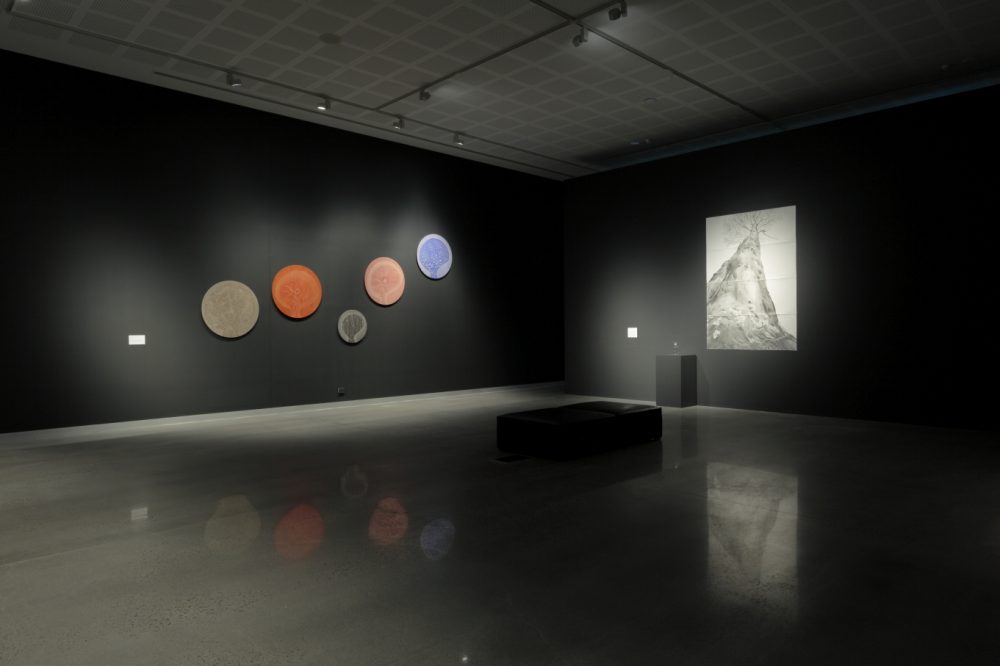
Installation image of Debbie Symons work ‘Connection’ at WAMA For Art and Nature.
Symons’ practice seeks to make visible the often unseen systems that underpin life on Earth, biological networks, data systems, and global economies, inviting reflection on interdependence, responsibility, and the future of human and non-human coexistence.